
1. Introduction
Construction stones are among the oldest and most fundamental materials used in civil engineering and construction. From ancient monuments and historical buildings to modern infrastructure, stones have played a crucial role in shaping the built environment. Even with the advancement of modern materials such as concrete and steel, construction stones remain widely used due to their strength, durability, availability, and aesthetic value.
Understanding construction stones is essential for students and professionals in civil engineering, architecture, and construction management. Proper selection, testing, and application of stones ensure safety, durability, and cost-effectiveness in construction projects.
This article provides a detailed and comprehensive overview of construction stones, covering their types, properties, testing, uses, advantages, limitations, and learning pathways.
2. What Are Construction Stones?
Construction stones are naturally occurring rock materials extracted from quarries and used in construction works. After extraction, stones are cut, shaped, or crushed depending on their intended application.
Stones are mainly used for:
- Structural works
- Masonry construction
- Road construction
- Flooring and paving
- Decorative and architectural purposes
The performance of a stone in construction depends on its physical, mechanical, and chemical properties.
3. Classification of Construction Stones
Construction stones can be classified based on different criteria.
a) Classification Based on Geological Origin
i) Igneous Rocks
Formed by the solidification of molten magma.
- Examples: Granite, Basalt
- Properties: Very strong, hard, durable
- Uses: Foundations, bridges, heavy structures
ii) Sedimentary Rocks
Formed by deposition and compaction of sediments.
- Examples: Limestone, Sandstone
- Properties: Moderate strength, easy to work
- Uses: Masonry, buildings, cladding
iii) Metamorphic Rocks
Formed when existing rocks change due to heat and pressure.
- Examples: Marble, Slate
- Properties: Dense, durable, aesthetic
- Uses: Flooring, roofing, decorative works
b) Classification Based on Structure
- Stratified stones: Layered structure (sandstone, limestone)
- Unstratified stones: No layers (granite, basalt)
- Foliated stones: Thin layers (slate)
4. Properties of Good Building Stones
A good construction stone must possess the following properties:
a) Strength
The stone should have high compressive strength to carry loads safely.
b) Durability
It must resist weathering, abrasion, and chemical attack.
c) Hardness
Hard stones resist wear and tear, especially in flooring and road works.
d) Toughness
Ability to withstand impact loads.
e) Porosity and Water Absorption
Low porosity is preferred to prevent moisture penetration.
f) Appearance
Color, texture, and finish are important for architectural works.
5. Tests on Construction Stones
To ensure quality, stones are tested before use.
a) Compressive Strength Test
Determines the load-carrying capacity of stone.
b) Water Absorption Test
Measures the amount of water absorbed by stone.
c) Abrasion Test
Checks resistance to wear, especially for pavements.
d) Impact Test
Evaluates toughness.
e) Acid Test
Assesses resistance to chemical attack.
Testing ensures stones meet engineering standards and specifications.
6. Common Types of Construction Stones and Their Uses
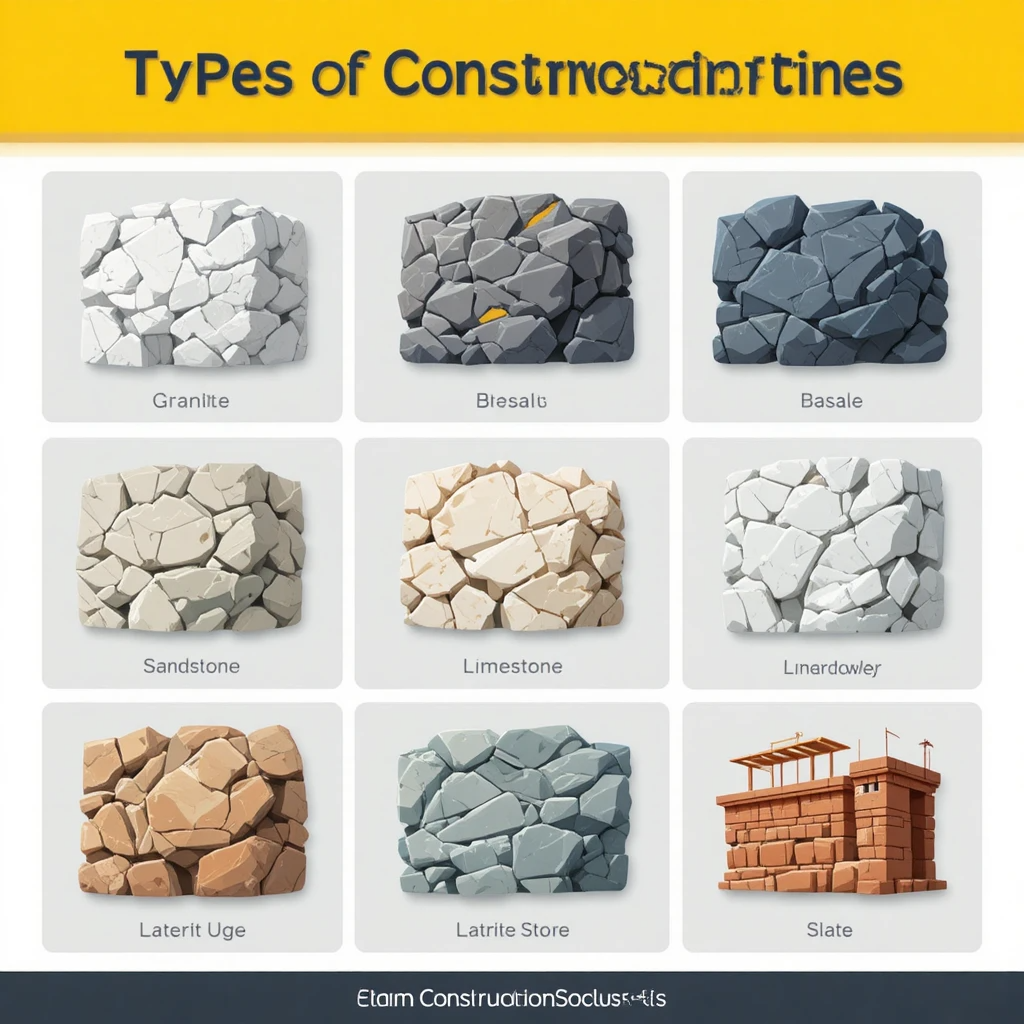
a) Granite
- Very hard and durable
- High compressive strength
- Used in foundations, columns, bridges, flooring
b) Basalt
- Dense and fine-grained
- Excellent strength
- Used in road construction and concrete aggregates
c) Limestone
- Easy to cut and shape
- Moderate strength
- Used in masonry and cement manufacturing
d) Sandstone
- Good appearance
- Moderate durability
- Used in building walls and cladding
e) Marble
- Attractive and smooth finish
- Used for flooring, cladding, and decorative works
f) Slate
- Thin, layered structure
- Water-resistant
- Used in roofing and flooring
7. Uses of Construction Stones in Civil Engineering
Construction stones are widely used in:
- Masonry works
- Foundations
- Retaining walls
- Bridges and dams
- Road metal and railway ballast
- Flooring, paving, and roofing
- Architectural and decorative works
Their application depends on strength, durability, and cost.
8. Advantages of Construction Stones
- High compressive strength
- Long service life
- Natural and environmentally friendly
- Fire and weather resistant
- Low maintenance
- Aesthetic appeal
These advantages make stones suitable for long-lasting structures.
9. Limitations of Construction Stones
- Heavy self-weight
- Difficult transportation
- Limited tensile strength
- Skilled labor required for dressing and laying
- Not suitable for very tall modern structures
These limitations are addressed by combining stones with concrete or steel.
10. Comparison of Construction Stones with Modern Materials
- Stones vs Concrete: Stones are natural and durable; concrete is more versatile
- Stones vs Steel: Stones are heavy and rigid; steel is light and flexible
Modern construction often uses stones alongside concrete and steel for optimal performance.
11. Sustainability and Environmental Aspects
Construction stones are:
- Natural materials
- Reusable and recyclable
- Long-lasting, reducing replacement needs
However, quarrying must be managed responsibly to minimize environmental impact.
12. The Future of Construction Stones
Despite modern materials, stones remain relevant due to:
- Sustainable construction trends
- Heritage conservation
- Architectural aesthetics
- Use in landscaping and eco-friendly designs
Innovations in stone cutting and finishing are expanding their applications.
13. Learning Construction Stones
Understanding construction stones is essential for civil engineering education and practice.
Key Learning Areas
- Stone classification and properties
- Testing methods
- Selection criteria
- Site applications
- Quality control
Learning Through SamoSkill
At SamoSkill, every technical article is supported by related professional courses available in the Courses section. Learners can find:
- Building materials courses
- Construction technology training
- Practical civil engineering lessons
- Beginner to advanced learning paths
This approach ensures that students and professionals gain both theoretical knowledge and practical skills on one platform.
14. Conclusion
Construction stones have been a cornerstone of civil engineering for centuries. Their strength, durability, and natural beauty make them indispensable in many construction applications. Proper understanding of stone types, properties, testing, and uses ensures safe and economical construction.
For students, mastering construction stones builds a strong foundation in building materials. For professionals, continuous learning helps in selecting the right material for each project. Platforms like SamoSkill enhance learning by combining detailed articles with practical, course-based training.
In construction, strong buildings start with the right materials and stones remain one of the strongest foundations.