
1. Introduction
Concrete mixing is one of the most fundamental and critical processes in civil and structural engineering. The quality, strength, durability, and performance of any concrete structure depend largely on how well the concrete is mixed. Incorrect mixing can lead to weak concrete, cracks, segregation, honeycombing, and long-term structural problems.
Among the various grades of concrete used in construction, M15 concrete is one of the most commonly used grades for basic structural and non-structural works. It is widely applied in foundations, slabs, pathways, flooring, and plain cement concrete (PCC) works.
This article provides a detailed and comprehensive explanation of concrete mixing using M15 grade, covering materials, mix proportion, mixing methods, quality control, common mistakes, applications, and learning pathways.
2. What Is Concrete Mixing?
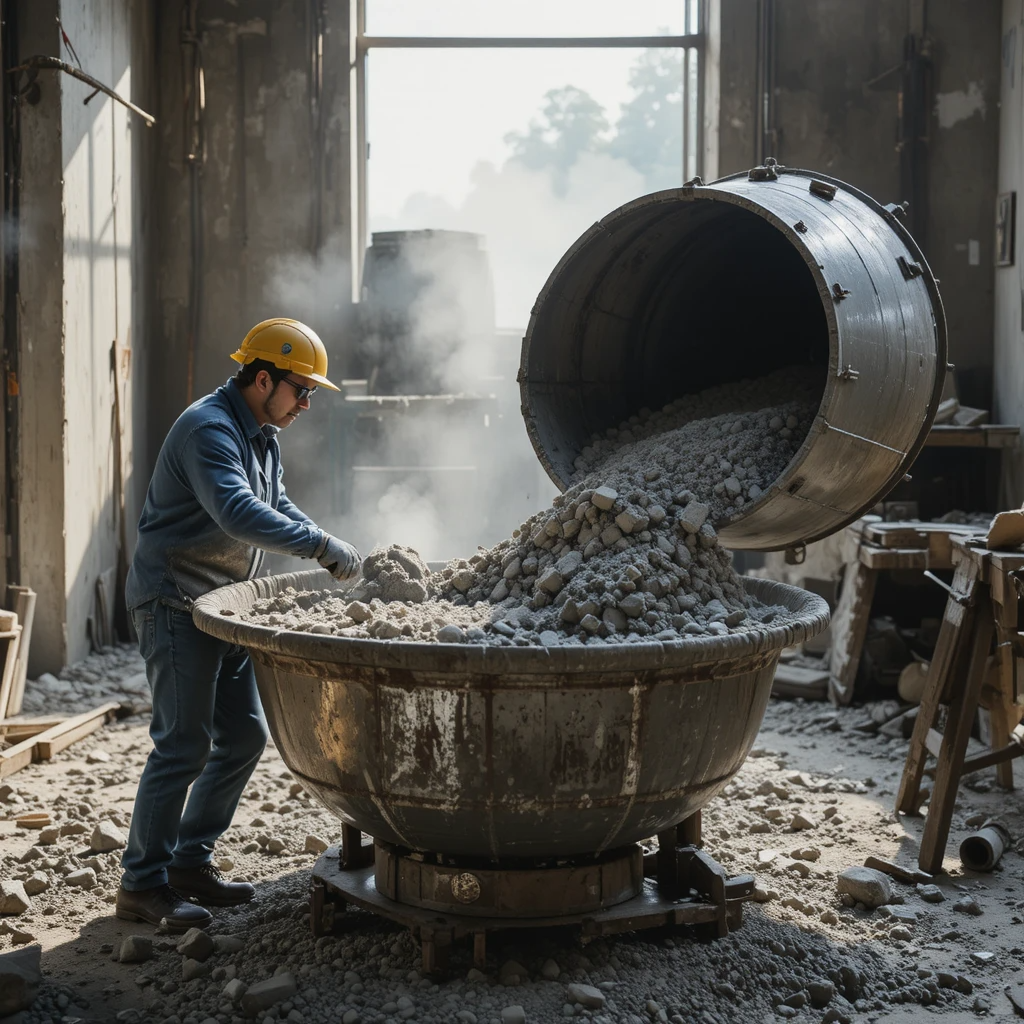
Concrete mixing is the process of combining cement, fine aggregates (sand), coarse aggregates (gravel or crushed stone), and water in correct proportions to produce a uniform, workable, and strong concrete mix.
The objective of concrete mixing is to:
- Coat all aggregates with cement paste
- Achieve uniform distribution of materials
- Ensure proper workability
- Develop the required strength after curing
Concrete can be mixed manually (hand mixing) or mechanically using concrete mixers.
3. What Is M15 Concrete?
M15 concrete is a nominal mix concrete where:
- M stands for Mix
- 15 represents the characteristic compressive strength of 15 MPa (N/mm²) at 28 days
M15 concrete is typically used for:
- Plain cement concrete (PCC)
- Flooring and pathways
- Levelling courses
- Foundations for light structures
- Non-load bearing elements
4. Materials Used in M15 Concrete
a) Cement
Ordinary Portland Cement (OPC) or Portland Pozzolana Cement (PPC) is commonly used. Cement acts as the binding material that holds aggregates together.
b) Fine Aggregate (Sand)
Clean, well-graded sand free from clay, silt, and organic impurities is essential for good concrete quality.
c) Coarse Aggregate
Crushed stone or gravel with suitable size (usually 20 mm maximum) provides strength and bulk to concrete.
d) Water
Clean, potable water is used for mixing and curing. Water quality directly affects concrete strength.
5. Mix Proportion of M15 Concrete
The standard nominal mix proportion for M15 concrete is:
M15 Mix Ratio
1 : 2 : 4
- 1 part Cement
- 2 parts Sand
- 4 parts Coarse Aggregate
Water-Cement Ratio
- Typically ranges between 0.45 – 0.60
- Must be controlled to avoid weak or overly stiff concrete
Correct proportioning is crucial to achieve the desired strength and workability.
6. Methods of Concrete Mixing (M15)
a) Hand Mixing
Hand mixing is suitable for small-scale works.
Procedure:
- Spread sand evenly on a clean platform
- Add cement and mix dry until uniform color is achieved
- Add coarse aggregate and mix thoroughly
- Add water gradually while mixing
- Continue mixing until uniform consistency is obtained
Limitations:
- Lower quality control
- Labor-intensive
- Not suitable for large projects
b) Machine Mixing
Machine mixing is recommended for better quality and consistency.
Procedure:
- Add coarse aggregate into the mixer
- Add sand and cement
- Dry mix for 1–2 minutes
- Add measured water gradually
- Mix until uniform concrete is obtained
Advantages:
- Better strength and uniformity
- Faster production
- Suitable for medium and large projects
7. Workability of M15 Concrete
Workability refers to how easily concrete can be mixed, placed, compacted, and finished.
Factors Affecting Workability
- Water content
- Aggregate shape and size
- Mixing time
- Temperature
For M15 concrete, moderate workability is usually sufficient for PCC works.
8. Placing and Compaction of M15 Concrete
Proper placing and compaction are essential after mixing.
Placing
- Concrete should be placed immediately after mixing
- Avoid free fall from excessive height
- Place concrete in layers
Compaction
- Hand tamping for small works
- Mechanical vibration for better compaction
Poor compaction leads to voids and reduced strength.
9. Curing of M15 Concrete
Curing is the process of maintaining moisture and temperature to allow cement hydration.
Curing Methods
- Water curing (ponding, spraying)
- Wet covering (hessian cloth)
Curing Duration
- Minimum 7–14 days
- Ideal curing improves strength and durability
10. Quality Control in M15 Concrete Mixing
To ensure quality:
- Use accurate material measurements
- Maintain proper water-cement ratio
- Avoid excessive water
- Ensure uniform mixing
- Conduct cube strength tests if required
Quality control prevents structural defects and premature failures.
11. Common Mistakes in Concrete Mixing
- Adding excess water
- Poor proportioning of materials
- Inadequate mixing time
- Using contaminated aggregates
- Delayed placing after mixing
Avoiding these mistakes ensures durable and strong concrete.
12. Advantages and Limitations of M15 Concrete
Advantages
- Easy to mix and place
- Economical
- Suitable for small and medium works
- Widely available materials
Limitations
- Lower strength compared to higher grades
- Not suitable for heavy load-bearing structures
13. Applications of M15 Concrete
M15 concrete is commonly used for:
- Plain cement concrete (PCC)
- Flooring and pavements
- Foundations for low-rise buildings
- Levelling courses
- Drainage works
14. Learning Concrete Mixing (M15)
Mastering concrete mixing is essential for every civil engineer and construction professional.
Key Skills to Learn
- Material selection
- Mix proportioning
- Mixing methods
- Workability control
- Quality assurance
- Site practices
Learning Through SamoSkill
At SamoSkill, every technical article is supported by related professional courses. In the Courses section, learners can find:
- Concrete technology courses
- Concrete mixing and batching training
- Practical site-based learning
- Beginner to advanced civil engineering courses
This integrated approach allows students and professionals to learn both theory and real-world application on one platform.
15. Conclusion
Concrete mixing is the foundation of successful construction, and M15 concrete plays a vital role in many basic and essential works. Proper understanding of materials, mix proportions, mixing methods, and curing practices ensures strong, durable, and cost-effective concrete.
For students, mastering concrete mixing builds a strong engineering foundation. For professionals, continuous improvement in mixing techniques ensures quality construction. Platforms like SamoSkill enhance learning by combining detailed articles with practical, skill-focused courses.
In construction, good concrete starts with correct mixing and M15 concrete remains a key building block of modern infrastructure.